
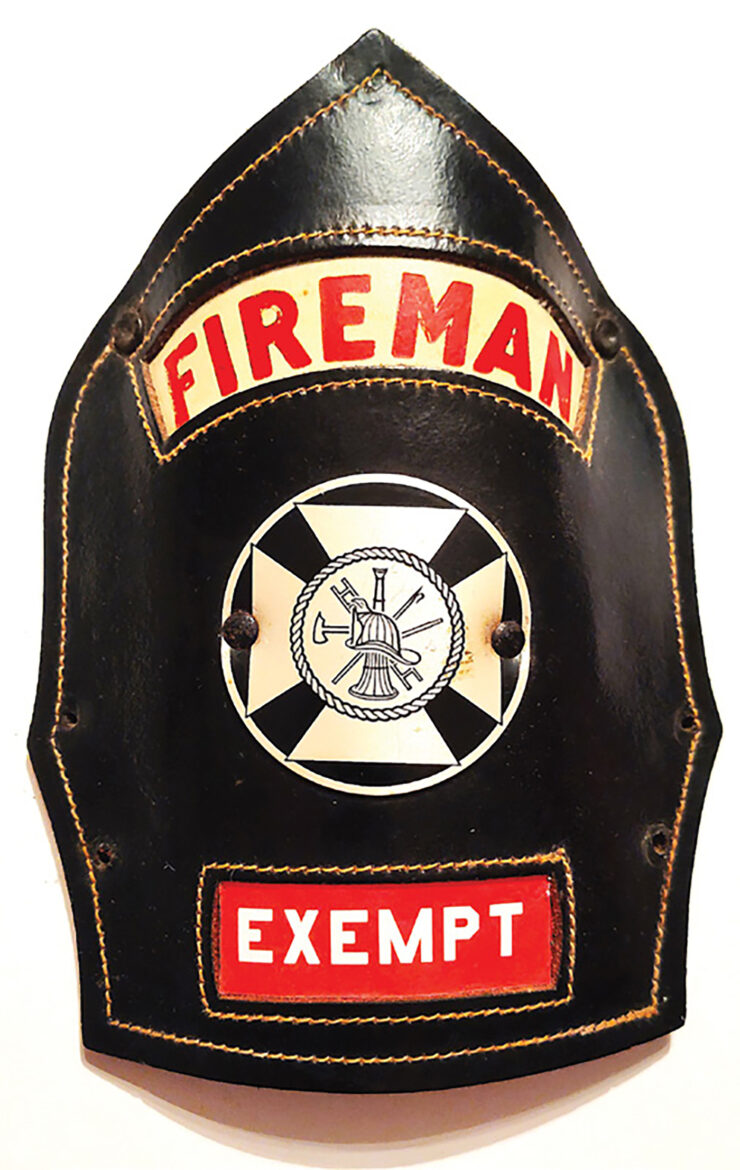
A Part of Fire Service History©
In this series, A Part of Fire Service History, we have covered many of the occurrences that brought change to the Fire Service. Based on these changes came the establishment of traditions founded on the events and related occurrences of the past. Over forty years ago when I had the opportunity to enter the field of Emergency Services, little did I know those early days of my career would today be consider past history. As senior (ancient) Firefighters we still have much in the way of advice and experience to share with the new generations of First Responders. It is important that as we share the history of the Fire Service to these new entrants into the profession we provide the true and correct history. It is unfortunate that over the years assumptions and tailboard tales have created fallacies that continue to subvert our grand and glorious Fire Service history. Along those lines this chapter will cover a unique term that originally came about as part of cultural changes in the Fire Service.
This chapter continues the practice of using the term Fireman when the use is historically appropriate. In addition some historical references to Fire Engines will use the term “Enjine” for “Fire Engine”, a common spelling in Colonial times, and still used by some fire organizations today.1
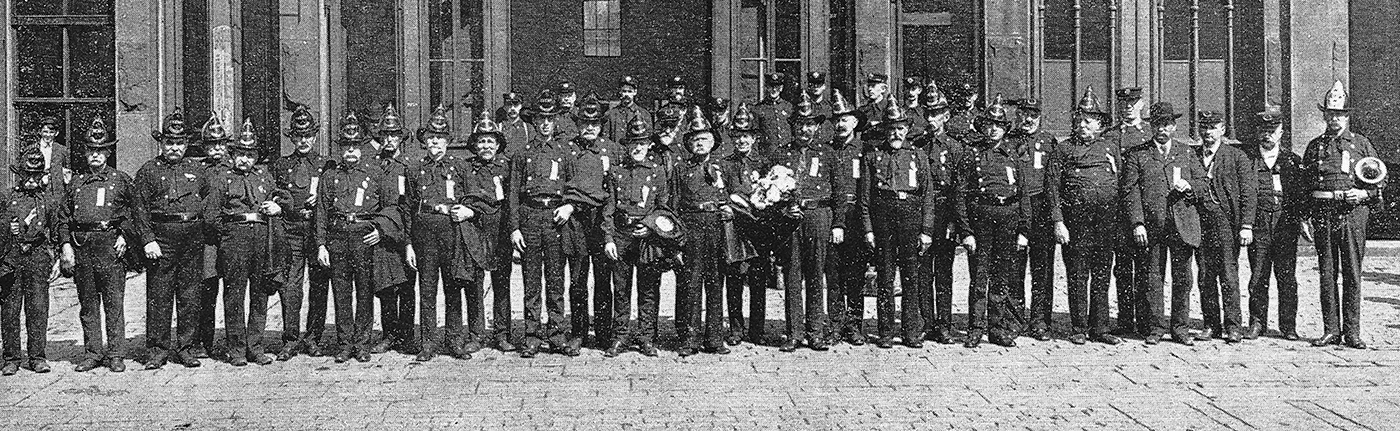
December 11, 1905, Rochester, NY, Program Booklet, 1905. Assumed to be in the public domain. Author’s collection.
Exempt Firemen
In discussions about Fire Service history with newer generations of Firefighters, some historical terms along with associated artifacts are misinterpreted today. One of the terms is “Exempt Firemen”. To understand the term and its significance, we need to review the history of the early American Fire Service.
In researching the term “exempt”, the only specific fire service definition was found in the National Fire Protection Association’s (NFPA) book on Fire Terms, A Guide To Their Meaning and Use, published in 1980. It defines the term “Exempts” as:
Volunteers fire fighters in certain states who have served a prescribed period of active duty and retains status on the social roles of the fire department.2
This definition is perhaps relevant to the more modern time period, but leaves out the history of where and when the term originated. Interestingly, even though the term still has applicability today in some states, the later editions of Terms did not reference exempt fire fighters at all.3
An early American dictionary from 1846 defines the term “Exempt” as: “A person exempted from the performance of certain duty or service as from paying a tax or performing military duty”4 This perhaps being a more accurate definition regarding this discussion as it reflects the historical time period being referenced.
In the early days of the American Fire Service, it was an honor to be selected as a member of a Volunteer Fire Company. However, besides the prestige of being a firemen and being looked up to perhaps as a hero for saving lives and property, the individuals served without any compensation or benefits. Answering calls day or night, required an individual to miss work activities during the day or lose sleep at night, along with the possibility of damaged clothing from fires. Being a Firemen required significant personal sacrifice, let alone the potential for serious injury or the loss of their life.
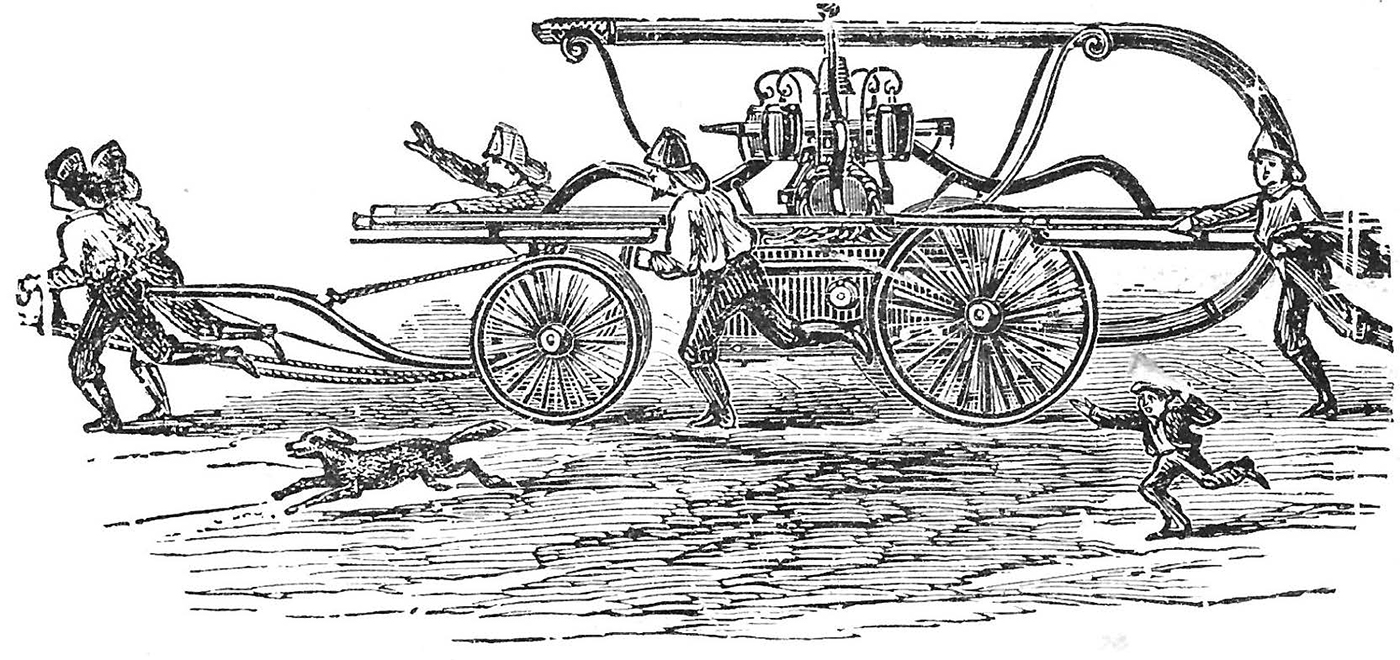
December 11, 1905, Rochester, NY, Program Booklet, 1905. Assumed to be in the public domain.
Two of the primary volunteer jobs related to community or civic service in the American colonies were the need for Militiamen and Firemen. Militias were made up of local citizens who served as a volunteer armed military force to protect the community from hostile groups and maintain order. In most cases, like Firemen they served for the good of the community without compensation (pay). However, as an enticement for their service it became a custom for Militiamen to be exempt from other civic activities such as jury duty or other mandatory public works projects for the community. Using Militia service as a model, some local communities would follow suit with Firemen being exempt from serving jury duty or militia service while serving as Firemen. When this exemption for Volunteer Firemen first began is hard to answer, but the first occurrences appear to have been in the New England communities of the American Colonies during the colonial period.5 The practice of exemptions for Firemen continued into the early days of the United States. In 1816 Firemen in New York formed one of the first Exempt Firemen organizations.6
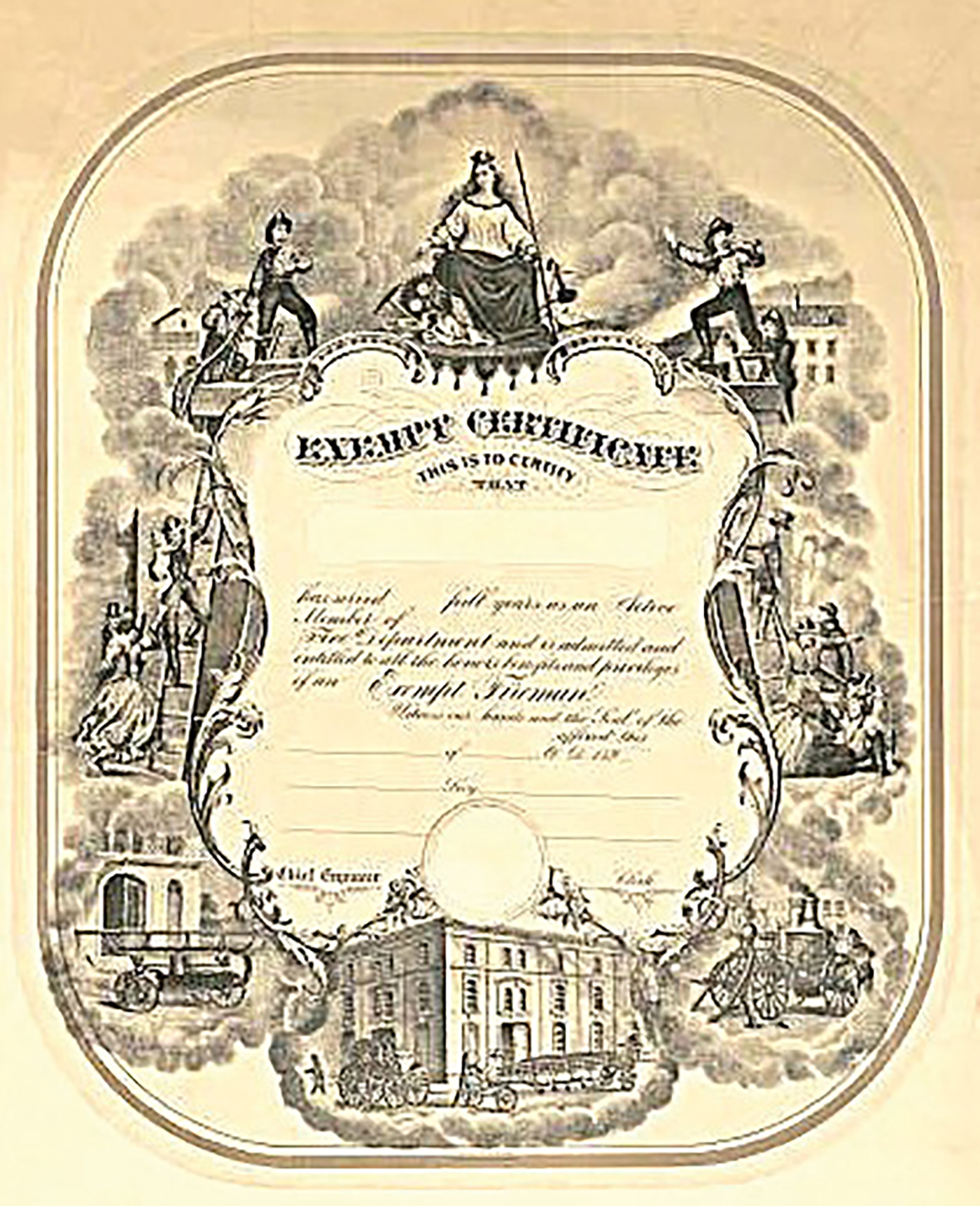
Over time east coast customs spread to the west coast and In California the State Legislature approved an Act Exempting San Francisco Firemen in 1853. Firemen that had actively served for five years, and had a certificate signed by the Chief Engineer or other Fire Department Official:
should be entitled to a certificate as an exempt fireman, which should ever release him in the State of California from jury or military service.7
Because of the substantial numbers of Firemen who claimed exemption, an organization called the “Exempt Fire Company” was established in 1860, with state recognition and sanction in 1862.8 The Exempt Company was given a fire house and apparatus and responded on fires as a back-up resource for the community.
These benefits expanded to a lifetime exemption for individuals actively serving in Militias or Fire Companies for a minimum of a set number of years. Service requirements for Firemen generally ranged from five to twenty years of active service to be eligible for permanent exemption.
As Volunteer Fire Companies began to be replaced by authorized paid Fire Departments in a municipality, Exempt Firemen’s Associations were formed to represent the displaced volunteers. A number of these groups retained their old hand-pump “Enjines” and were a reserve forces for the city backing up the Fire Department if needed. Over time these associations became more of a social organization. Some groups still hold competitions or Fire Musters today and compete in various events with their antique fire apparatus.
As has been seen in previous chapters of this fire Service history series, New York City provides a good historic example of the American Fire Service. This includes the development of Volunteer Firemen’s Associations and Exempt Associations. Covered previously in this series was the change from Volunteer Fire Companies in New York to a Metropolitan Fire District with a career Fire Department at the end of the Civil War in 1865. The returning military veterans that were former Firemen in Volunteer Fire Companies (many of them had formed Fire Zouave military companies during the war) were upset at the loss of their Fire Companies and their status as Volunteer Firemen. Though some would seek jobs with the new career department, many would resist the transition and the loss of their status. Returning veterans and current Volunteers would move to form Volunteer Firemen’s Associations and Exempt Firemen’s Associations.9 In many cases, the original Volunteer Fire Companies had purchased and owned their fire apparatus, equipment, and fire houses. Though the state legislation that created the district and the Metropolitan Fire Department (MFD) order the Fire Companies to turn over their apparatus, equipment, and in some cases fire houses, the Volunteers resisted. There are reports of Fire Companies hiding their ornate hand pumped fire apparatus and hose carts/wagons to keep them from being confiscated. Eventually an understanding was reached and the Volunteer Fire Companies that retained their apparatus and fire houses were designated as reserves to the MFD. Thus retaining their status as Firemen and being able to finish their service time and earn their life designation as “Exempt Firemen”.
The City of Rochester, NY was originally served by various volunteer Fire Companies. In 1866 the city established a career Fire Department, and over time gradually phased out all the Volunteer Fire Companies. The state first enacted legislation covering exempt Firemen in 1816. Like other volunteers in the state that had not completed their service requirements for permanent exemption when a career Fire Department was enacted, a group of volunteers organized the Exempt Firemen’s Association of the City of Rochester in 1869, finally becoming incorporated in July of 1902. Those with five years fire protection service were “entirely exempt from serving as a juror in any of the Courts in this State, and from all militia and military duty, whatever, except in case of insurrection or invasion.”10 Apparently the added clause of exception for “insurrection and invasion” was related to the experience of the Civil War. Similar to other Exempt Associations, they also provided other assistance to their Firemen. They established a burial fund and purchased a Firemen’s burial plot expanding it in 1880 and dedicating a monument.”11 To raise necessary funds for the association and provide burial services for Firemen, the members hosted dances and other community social events. The members also participated in various state meetings and Firemen’s musters.
Labor Exemption
Today, the term exempt or exemption also carries a different meaning related to the career service. As related in the previous chapter on “Life in the Early Career Fire Department”, the Fair Labor Standards Act (FLSA) signed into law in 1938 created minimum wage and maximum work hour regulations.12 However it was not until 1974 that the FLSA was first applied to state and local governments with a final ruling in 1985 by the Supreme Court. This impacted the distinctive work schedules of career Fire Departments, such as 12, 14, or 24 hour shift assignments. To minimize impact and work within accepted work schedules of Fire Departments, Congress created the “207K” exemption [FLSA – 29 USC 207(k)] in the FLSA to address the unique work schedules of Firefighters and Police Officers.13 A paid firefighter positon may be exempt from standard federal wage and overtime rules because of their job classification and shift work.14 As can be seen, this wage and work schedule exemption is a completely different situation than the original service duty exemption of the volunteer Fire Companies.
Conscription Versus Exemption
Even though local governments and some states legislature had enacted statutes to recognize and exempt Firemen from certain civic duties, over time these exemptions faced a number of challenges regarding conscriptions for military duty.
During the American Civil War, New York like most northern cities was supportive of maintaining the Union of the United States. Early on many citizens including Firemen volunteered for the United States Army or formed special military units. But as the war drug on with numerous bloody battles, military service became less popular. To replenish lost manpower in the Army, President Lincoln and the United States Congress enacted a conscription (draft) act. The first draft lottery took place in New York in July 1863.
The draft was unpopular with most citizens. One reason for its unpopularity was that wealthy men could get out of the draft by paying $300 for a substitute to serve in their place. Also, volunteer Firemen long exempt from militia or military service were no longer exempt from the draft act. A protest started in New York on July 13 and was spurred to violence by: “members of the Black Joke Engine Co. 33” of which several members had been drafted in the lottery draw.15 The rioters began setting fires and attempting to destroy government buildings in the city. Other Fire Companies stood strong against the rioters and did the best they could to save lives and property from the on slot. After almost a week of riots federal troops arrived and were able to quell the uprising. The event saw both dreadful actions by some and heroic actions by other firefighters. This violent event was a regrettable period in the history of the United States Fire Service. The insurrection started by volunteers was one more reason for the city fathers, insurance agents, and citizens to call for a career Fire Department that would be more readily governed by the city of New York.
The American Civil War was not the last time exemptions for Firefighters were overturned or challenged. In World War II the U.S. Selective Service was drafting large numbers of fit young men for military duty with few exceptions. A number of major cities fought to exclude Firefighters from the national draft for fear of depleting their trained and experienced fire protection forces. In some cases municipal governments tried to offer compromises to obtain deferments “for firefighters and police with more than two years of experience.”16 In the last year of the War, President Roosevelt was demanding the conscription of “a million more men in uniform.”17 The traditional exemption from military service for Firemen disappeared for hundreds of Firefighters till the war’s end. This also created a shortage of trained and experienced Firefighters for maintaining protection on the home front.
Exempt Firemen Today
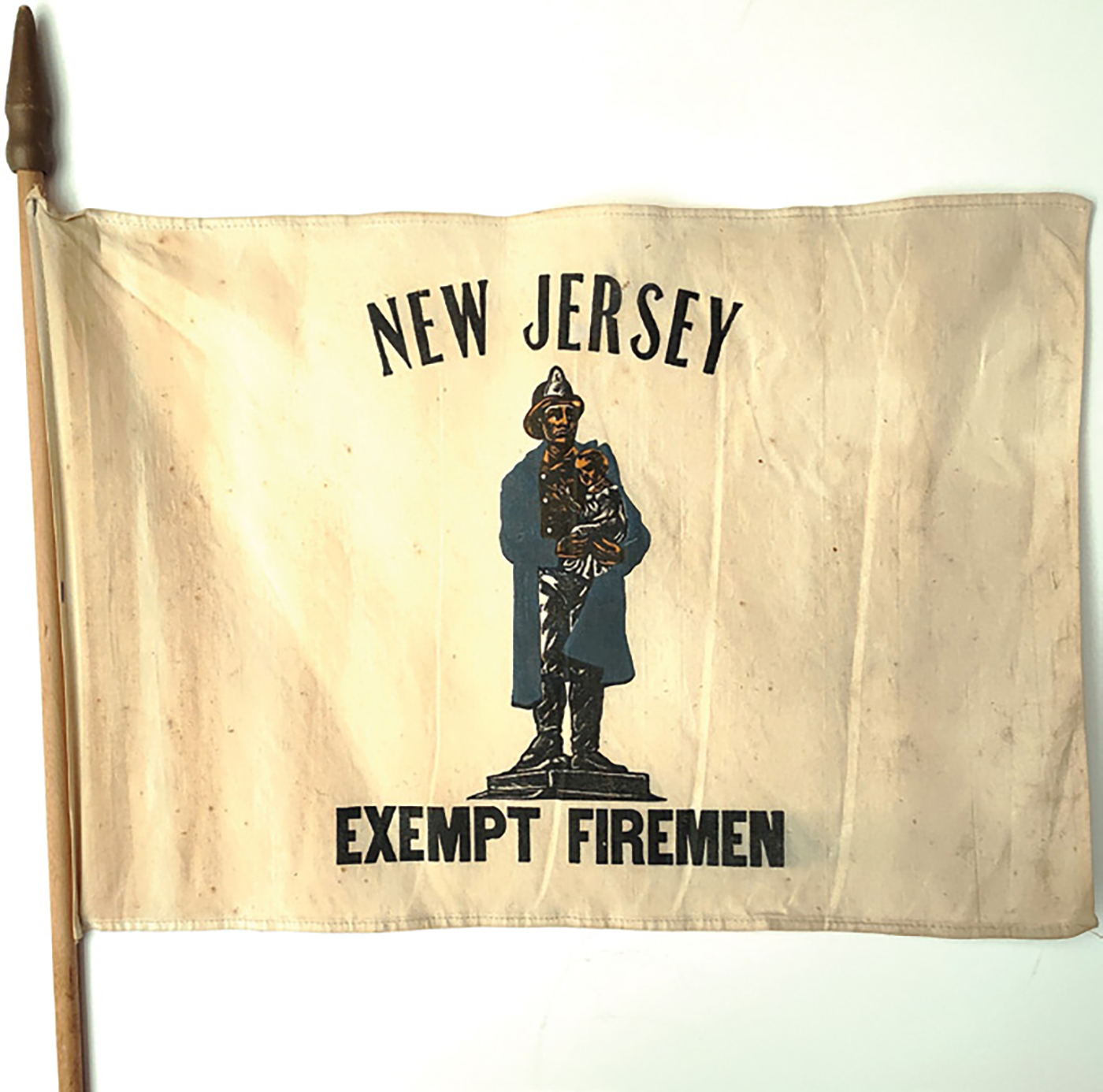
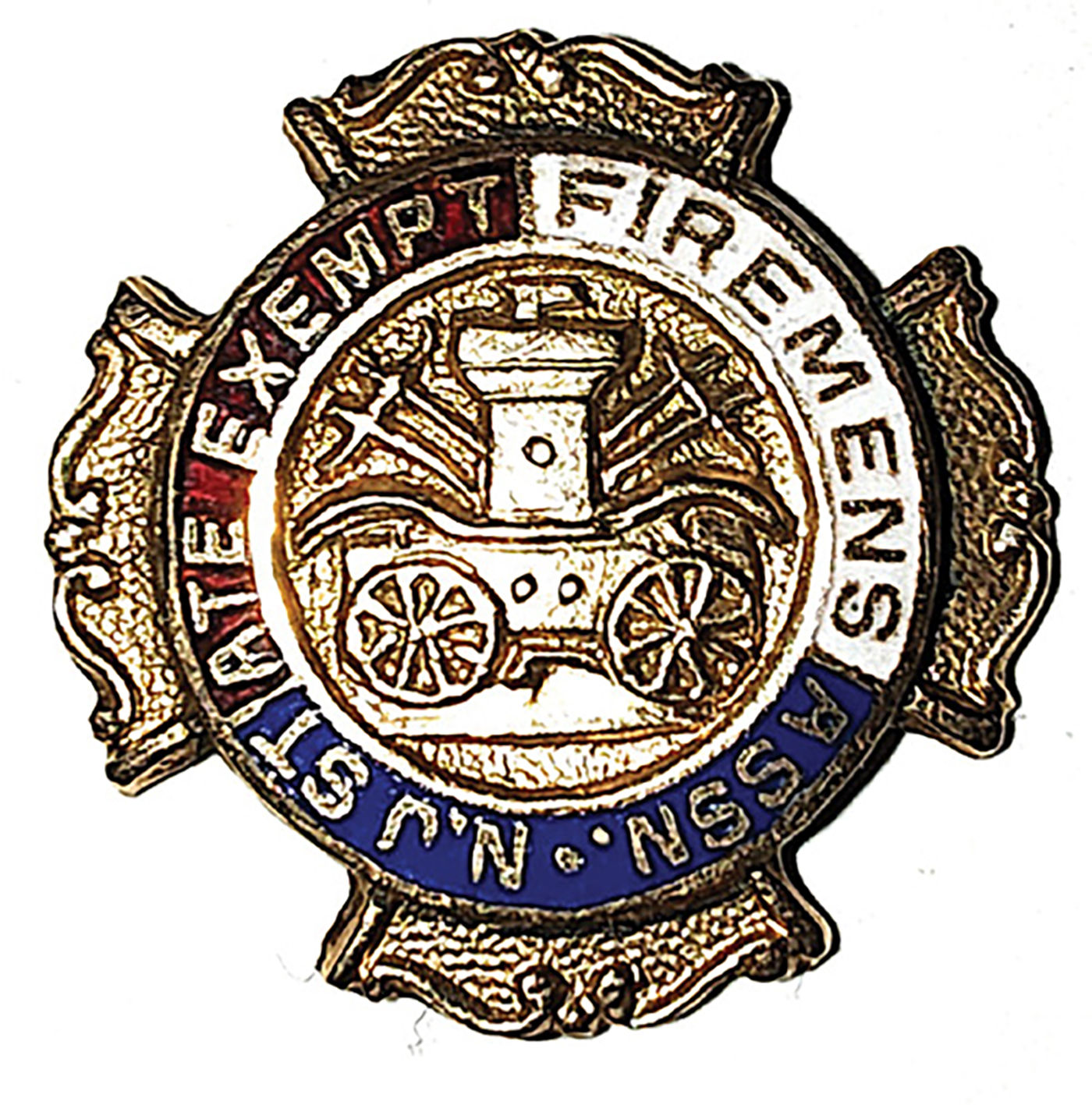
Regarding volunteer Firefighter service today, the original exempt tradition carries on in some communities or states where volunteer Firefighters can be exempt from civic duties for their service, as well as be eligible for other benefits. The State of New Jersey has legislation that provides for the following:
The Exempt Firefighter obtains an Exempt Certificate after seven (7) years duty from the municipality in which his/her fire company is operational and part of that fire department. This certificate is then filed with the County Clerk and entitles the firefighter to certain benefits by statute.18
In recent years there have been some additional states that have pursued legislation that would exempt Firefighters from jury duty.19 As history reveals, this is not really a new idea, but a return to a practice that was common back in the early days of the American Fire Service.
Benefits for exempt Firemen varied by community, state, and time period. In addition to exemptions from military service and jury duty, research found some communities provided various tax exemptions for Firemen such as individual property tax relief, poll tax, road tax or road work projects exemptions. These historic benefits for being a Volunteer Fireman helped incentivize local citizens to serve in the Volunteer Fire Companies, as well as garner support from the family for members to serve. Today a number of Volunteer Fire Departments looking for ways to encourage recruitment and retention of Volunteers have subsidized retirement plans for volunteers that provide a modest extra retirement income for members as an enticement for meeting service longevity tenures. Other service inducements may be Income tax credit, and job protection when responding to emergency calls and other deployments.
Changing Culture and Continuing Traditions
In some parts of the United States the term of Exempt Firemen still applies to legislation or proclamations that provide state or local exemptions for volunteer Firefighters that have met specific service requirements. In other areas of the country, the term has all but been forgotten as an archaic term from the past. Unfortunately, a number of recognized Fire Service sources have deleted this term from newer publication, thus obfuscating the true history of the American Fire Service.
However, there still remains paper paraphernalia, and other artifacts that document this historic past. Exempt Firemen memorabilia from the historic past includes flags, banners, badges, certificates and other mementos. They can be found currently on display in various Fire Museums or Fire Organizations recalling the valiant days of the Volunteer Firemen and their importance to America’s early public fire protection.
In 1910, FDNY Fire Chief Edward Croker said: “when a man becomes a fireman, his act of bravery has already been accomplished.”20 Though his remarks at the time were related to career Firefighters, his words profoundly express the true significance of an individual who commits to protecting lives and property from the ravages of fire, whither they perform these duties as an occupation or an avocation. In the early days of America, some citizens chose to place others before self and defend their community through volunteering for Fire Protection duties. They did this as a service to their community, not for the modest benefits of exemption proclamations. In the end though as Volunteer Fire Companies were phased out in their communities, Exempt Firemen’s Association provided a way for them to continue to serve as an auxiliary force or maintain their historical connection to the early Fire Service that protected their communities.
Authors Comments
The author wishes to recognize and thank the fire service personnel and organizations for their assistance in the development of this chapter. In particular, the author expresses his appreciation to the University of Missouri Ellis Library/Lending Library for assisting the author in obtaining the inter-library loan of various research documents and archival materials.
The author also wishes to recognize all the various Historians and Authors for their extensive and invaluable work in Fire Service History through artifact notes, articles, and books that have been used for research purposes by the author and footnoted in this series. May their work continue to endure the ages and preserve the true history and traditions of the American Fire Service.
The A Part of Fire Service History Series Articles are copyrighted © 2023 – 2026 by the author and are published under permission granted to the FFAM.
Endnotes
- The word “Enjine” is an archaic term that was used in relation to a hand-pumped fire engine during Colonial and early American period of the United States. It was pronounced as spelled, being a term of affection and veneration for the fire engine by the engine company’s firemen.
- Ralph W. Burklin, and Robert G. Purington, “Exempts”, National Fire Protection Association’s (NFPA) book on Fire Terms, A Guide To Their Meaning and Use, NFPA, Boston, MA, 1980, p. 59.
- Jennifer L. Reed, Editor, Illustrated Dictionary of Fire Service Terms, NFPA, Jones and Bartlett Publications, Sudbury, MA, 2006.
- Joseph E. Worcester, Universal and Critical Dictionary of the English Language, “Exempt”, Wilkins, Carter, and Company, Boston, 1846, p. 260.
- Terry Golway, “The Great Calling of Firefighting”, American Heritage, November/December 2005, Vol. 56, Issue 6, copyright 1949-2024 American Heritage Publishing Co., from web article accessed July 3, 2025, https://www.americanheritage.com/great-calling-firefighting.
- Arnold Merkitch, Early Fire Helmets, Self-published, West Islip, NY, First edition, 1981, p. 65.
- “Exempt Fire Company”, The Exempt Firemen of San Francisco, Commercial Publishing Company, San Francisco, CA, 1900, p. 19, web book Digitized by the Internet Archive: http://www.archive.org/details/exemptfiremenofsOOexem.
- Ibid.
- Denny Randall, The Fireman’s Association of the State of New York, American Museum of Firefighting, Fireman’s Association of the State of New York (FASNY), Albany, NY, 2005, p. 8.
- “History”, Twenty-sixth Annual Dance of the Exempt Firemen’s Association, December 11, 1905, Program Booklet, Exempt Firemen’s Association, 1905.
- Ibid.
- Jonathan Grossman, “Fair Labor Standards Act of 1938: Maximum Struggle for a Minimum Wage”, U.S, Department of Labor, Washington, DC, 1978. Web article accessed Dec. 5, 2025: https://www.dol.gov/general/aboutdol/history/flsa1938.
- Curt Varone, “Origins of the 7K Firefighter Overtime Exemption”, Fire Log Blog, May 31, 2018, © 2025. Web article accessed Dec. 5, 2025: https://firelawblog.com/2018/05/31/origins-of-the-7k-firefighter-overtime-exemption/#:~:text=Answer:%20The%20law%20you%20are,with%20minimal%20impact%20to%20taxpayers.
- “Overview of the FLSA Rules for Firefighters”, County Technical Assistance Service, University of Tennessee Institute for Public Service, web article accessed July 3, 2025: chrome-extension://efaidnbmnnnibpcajpcglclefindmkaj/https://www.ctas.tennessee.edu/sites/default/files/FF+FLSA+Overview_Lauer_0.pdf.
- Terry Golway, So Others Might Live, A History of New York’s Bravest, the FDNY from 1700 to the Present, Basic Books, A Member of the Perseus Books Group, NY/NY, 2002, p.112.
- Ibid, p. 198.
- Ibid.
- New Jersey State Firemen’s Association, History of Association, Chapter Eight – Exempt Firemen, Copyright © 1999-2007, web article accessed July 3, 2025, https://njsfa.com/history_of_association_5.aspx#:~:text=The%20Exempt%20Firefighter%20obtains%20an,to%20certain%20benefits%20by%20statute.
- Firehouse.com News, “Bill to Exempt Firefighters, EMTs from Jury Duty Proposed in PA”, Sept. 28, 2017, Firehouse, Endeavor Business Media, 2025, web article accessed July 19, 2025: https://www.firehouse.com/home/news/12371010/pa-bill-seeks-to-make-firefighters-emts-exempt-from-serving-jury-duty-firefighter-news.
- “History Timeline”, Croker, The Fire and Life Safety Professionals, Croker Fire Drill Corp., 2026, website: https://crokerfiredrill.com/about/#:~:text=Croker%20which%20he%20shared%20with,bravery%20has%20already%20been%20accomplished.
 FFAM
FFAM