
The National Volunteer Fire Council (NVFC) Training Crew continues their free in-person face-to-face training commitment in various states. Most recently, Electric Vehicle Training was provided in Missouri on December 13 in Sedgewickville. This was their 3rd class in Missouri in the past two years.
NVFC membership continues to do well, having achieved a growth of 61% in the past 5 years. As a result, they are hiring an additional staff position to service this and future growth. During this same time frame, less than half of the other national organizations achieved any growth, and those that did reported an average of 5%. Individual NVFC Membership numbers in Missouri for 2025 vs. 2024 were down slightly, reflecting future growth opportunities.
Some interesting updates from the Fall Meeting in South Dakota. I will not get into OSHA, so I am moving on to the Codes & Standards Committee. They had several reports, but Hazmat (NFPA 470) detailed a fun fact (actually NOT) regarding the NFPA Committee make-up. NVFC has one member on 470, but the fact is that very few volunteers are on this important working group, and volunteer regions have a significant hazmat exposure compared to urban areas. Just look at where most incidents are occurring. Also, and even more telling of NFPA, only 17% of the entire 470 committee are connected to the fire service vs. manufacturing and transportation. Talk about special interest, but that is a typical reflection of NFPA Committees. If we can correct this imbalance, it will take years to do so. NFPA was present at this and other committee meetings, but continues to use their OLD excuse of “we do not write the standards, we just Shepard the process”. The West Virginia Director commented, “OK, but in that case your Shepard’s Hook is badly broken”. The 5-seconds of total silence that followed were priceless!
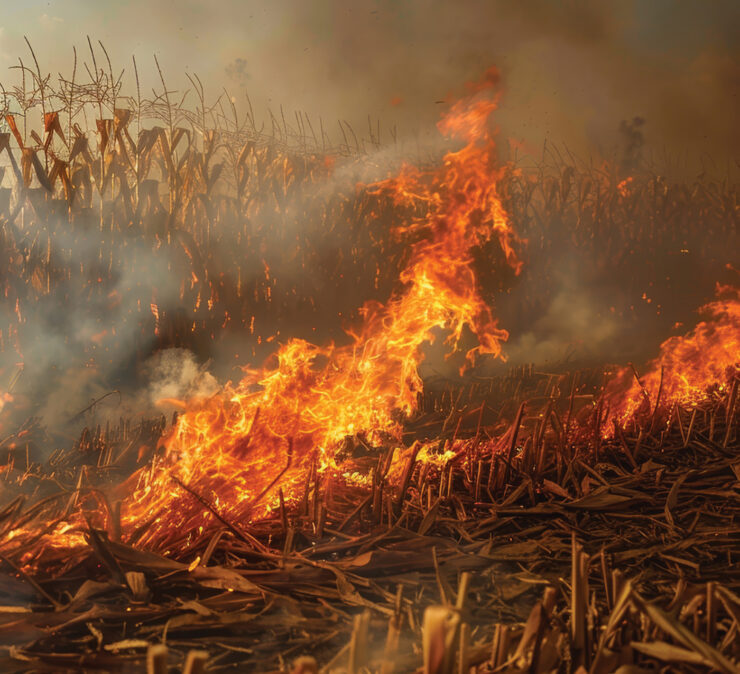
The Wildland Committee reported several interesting developments, but to pick just 3, I have the following. Grants continue to be available for now through the National Forest Service for hazmat and drone training, thinning fire loads, and prescribed burns. Soya Foam is continuing to make great strides as a PFAS-free alternative. It has checked the key boxes for Wildland use, showing great promise in structural and ARFF is next. I will wrap with a recent natural cover fire incident in Iowa, which cast a bright light on potential operational liability in allowing farm equipment to assist with natural cover fires. Yes, it was acknowledged that this is routinely done and provides major assistance in most cases. The short version of this 10-minute overview and discussion was that a combine auger took down power lines, causing a ground fire that got into standing corn thanks to 30+ mph winds. The fire department accepted an offer from a farmer to assist with a large 4-wheel drive tractor and disk cutting fire lines. However, fire (smoke) damaged his engine resulting in $75-K of repairs. His insurance policy did not cover this activity with Ag equipment, so he turned to the fire department and their insurance carrier. Beware of what you accept on and allow to be used on your fire scene. The point of the discussion was not to turn down real help but to be aware of and prepare for what can happen as a result in doing so, for whatever best-intended reasons.
The Legislative Committee had the usual discussions on AFG, SAFER, and several other grants, but the Fire Station Act got the most attention in this meeting. It is a one-time $750M pot of money, which is only believed to be a tiny step towards this larger and broad-based problem. Nothing close to the solution that is needed. Also, the application process to get one of these grants will likely discourage most from even making an attempt. When you do the math, it comes back as $15M per State, if given equally to each State, and that will not happen. Then compare $15M to States with station numbers like California, Texas, and New York. Long Island, NY, alone has 179 volunteer departments. This simple law of numbers vs. dollars shows the challenges.
Thank you for your time plus allowing Rob and I to serve on your behalf with NVFC.
 FFAM
FFAM